1900-1950: Separate and Unequal Reflection
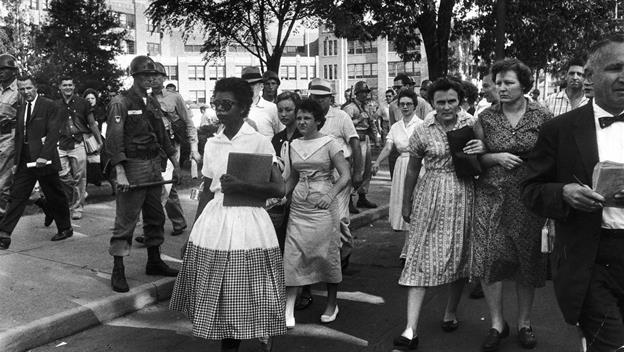
The progression of public education descended from controversial events that civic movements rightfully resisted against. Educational equality is essential in the United States, especially during the reform of the school system. Many protests confronted those issues nonetheless desegregation occurred at some educational institutions.
 During the 20th century, diverse communities were influenced by the American culture, known as Americanization, to become civilized with bilingual education. The program's purpose was to grant 'equality', but it indirectly manifested discrimination toward Non-English speaking students. The Historian, Gilbert Gonzales, asserts, "Educational theory at the time assumed that the persistence of the Spanish language constructed a barrier to educational achievement" (152). Similar to the black community, their culture was conveyed as an obtrusion to quality education. The Board of Education failed to notice that minority communities demanded for better education and equality.
In the Journal of Urban History, black youths in Boston disclosed their opinions about the value of education. As stated, "With their demands for a quality education and greater education decision-making power, black students rejected stereotypes of black youth as politically apathetic and juvenile delinquents"(Bundy 289), this correlates with the Netflix series "Teach Us All" that tributes the "Little Rock Nine". One of the speakers, Bradley, in the movie quoted his mother on the issue. "Bradley, you have two strikes. One you're male, and one you're black. Anybody going to have to give nothing for that"(Teach Us All). These bold statements are begging for an equal school system that doesn't discriminate against student based on their race, economic status and place of residence. These issues are awaiting for democratic action where the people speak for their children in poverty stricken environments.
The communities rely on public education systems to provide effective educational equality. It is important for their kids to gain opportunities to secure a better life for themselves. However, it affects them when the education system is not providing the institutions with the resources necessary and low-cost budgets. Poor students may feel discouraged, and drop out, even teachers, if there are no improvements that focus on suburban districts unlike those schools with mostly white kids who have better school funding and educational opportunities.
 During the 20th century, diverse communities were influenced by the American culture, known as Americanization, to become civilized with bilingual education. The program's purpose was to grant 'equality', but it indirectly manifested discrimination toward Non-English speaking students. The Historian, Gilbert Gonzales, asserts, "Educational theory at the time assumed that the persistence of the Spanish language constructed a barrier to educational achievement" (152). Similar to the black community, their culture was conveyed as an obtrusion to quality education. The Board of Education failed to notice that minority communities demanded for better education and equality.
In the Journal of Urban History, black youths in Boston disclosed their opinions about the value of education. As stated, "With their demands for a quality education and greater education decision-making power, black students rejected stereotypes of black youth as politically apathetic and juvenile delinquents"(Bundy 289), this correlates with the Netflix series "Teach Us All" that tributes the "Little Rock Nine". One of the speakers, Bradley, in the movie quoted his mother on the issue. "Bradley, you have two strikes. One you're male, and one you're black. Anybody going to have to give nothing for that"(Teach Us All). These bold statements are begging for an equal school system that doesn't discriminate against student based on their race, economic status and place of residence. These issues are awaiting for democratic action where the people speak for their children in poverty stricken environments.
The communities rely on public education systems to provide effective educational equality. It is important for their kids to gain opportunities to secure a better life for themselves. However, it affects them when the education system is not providing the institutions with the resources necessary and low-cost budgets. Poor students may feel discouraged, and drop out, even teachers, if there are no improvements that focus on suburban districts unlike those schools with mostly white kids who have better school funding and educational opportunities.

In elementary school, there were two programs, bilingual classes and regular classes. I had a friend who was born in the United States, but spoke only Spanish in her household. It was challenging for her to learn English so the school transferred her into bilingual courses. She failed the first term because their motives were to group her with students that speak the same language, not to improve her English. She was unsatisfied and disappointed with the method. Therefore, my friend urged her teachers that she preferred a regular classroom, which they went forth with the request. At the end, her native language became English and passed the grade level. If society demands for what these minority children deserve then their voices will be heard.
The comparison of reflecting our thoughts without a class discussion versus posting after we had a class discussion helps tremendously. Instead of struggling with no ideas or too many at the same time, this process can be paced step-by-step. The efforts of doing an assignment without a class discussion causes a single-minded strategy that can may go off topic. A class discussion allows you to gain different perspectives and better understanding of your writing that made sense before until it it is read aloud to your listeners.
References
Bundy, Tess.“Revolutions Happen through Young People!”: The Black Student Movement in the Boston Public Schools, 1968-1971. Journal of Urban History, 30 Jan. 2017.
“Teach Us All.” Netflix Official Site, 25 Sept. 2017.
Streep, M. Tyack, D. B., Bernard, S. C., Mondale, S., & Patton, S. B. (2001). School: The Story of American Public Education. Boston: Beacon Press.


No comments:
Post a Comment