Tuesday, February 26, 2019

"The Bottom Line" Reflection


1980-Present: The Bottom Line

Over the past century, the United States economy has lacked growth in their top industries overtime. The most competitive countries were Great Britain and Germany in the market. They had highly skilled experts who became successful business leaders who have succeeded in the trading business. For this reason, business involvement was incorporated into American public schools. The word "performance" influences this method of strengthening the nation's economy. Many students and teachers were appointed recognition for effective and efficient educational achievements. Like corporations, employees and management are rewarded when they meet their required goals, and penalized if they fail. It applies to the school system regulations, as well, if an institution underperforms then there is a risk of getting shut down. "Finally, where the bottom line matters in schooling - the classroom - no one knows for certain whether all the testing, all the required courses, and all the penalties and rewards get teachers to teach better and students to learn more" (Mondale 182). These developed individuals will contribute to the economy with high standards and skills.


During the year 1983, President Reagan created a report, "A Nation at Risk", which initiated a new wave of education reform in America's school system. The crisis in the education system showed that it had low standards and unprepared students for the real world. This phrase, "'You must be kidding'"(Meier 188), was exclaimed when there was a demand for alternative public schools to be built into existing spaces. This was a challenge that Deborah Meier, founder and former principle for Central Park East Harlem, found 'bold' and 'exciting'. Even if her reaction showed astonishment, it did not stop her from pursuing more opportunities for her students. So, she made it happen. Twenty schools increased into fifty-two schools in the same buildings. Each of them were different concentrations. For instance, sports school, writing school, performing-arts school, math and science schools. This type of commitment was not mentioned in Reagan's report. The report severely criticized the schools as the main problem for economic issues, but this was not the case.

The importance of having funded public schools is to provide our students with a better future, not to solely gain profits for companies. This sentence expresses true passion for the learners and not the providers. "I am not in this battle on education to save any institution," she said. "I am in here to save the lives of children by any means necessary" (Williams 193). A balance between equity and excellence strives for no limits in educational equality. Without students, there are no reasons to have operated institutions. Staff and faculty will lose their jobs and companies that were sponsored will fade away. Various methods of schooling like homeschooling, charter schools, and voucher programs have the essential sources to give each child the chance to right path and guidance. However, the question still lingers on: are these new strategies of education challenging the original movement of a common school or heading into a nation of complex academic standards?

References

Streep, M. Tyack, D. B., Bernard, S. C., Mondale, S., & Patton, S. B. (2001). School: The Story of American Public Education. Boston: Beacon Press.



Sunday, February 17, 2019

Part Three: "Separate and Unequal Reflection"


 1900-1950: Separate and Unequal Reflection
Image result for black and white little kid in class integration

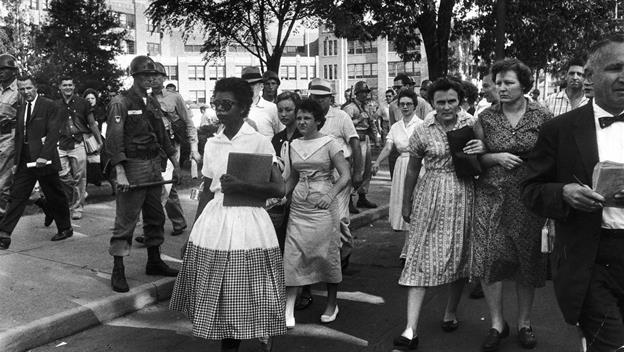
The progression of public education descended from controversial events that civic movements rightfully resisted against. Educational equality is essential in the United States, especially during the reform of the school system. Many protests confronted those issues nonetheless desegregation occurred at some educational institutions.

Image result for first black kids to attend white schoolDuring the 20th century, diverse communities were influenced by the American culture, known as Americanization, to become civilized with bilingual education. The program's purpose was to grant 'equality', but it indirectly manifested discrimination toward Non-English speaking students. The Historian, Gilbert Gonzales, asserts, "Educational theory at the time assumed that the persistence of the Spanish language constructed a barrier to educational achievement" (152). Similar to the black community, their culture was conveyed as an obtrusion to quality education. The Board of Education failed to notice that minority communities demanded for better education and equality.

In the Journal of Urban History, black youths in Boston disclosed their opinions about the value of education. As stated, "With their demands for a quality education and greater education decision-making power, black students rejected stereotypes of black youth as politically apathetic and juvenile delinquents"(Bundy 289), this correlates with the Netflix series "Teach Us All" that tributes the "Little Rock Nine". One of the speakers, Bradley, in the movie quoted his mother on the issue. "Bradley, you have two strikes. One you're male, and one you're black. Anybody going to have to give nothing for that"(Teach Us All). These bold statements are begging for an equal school system that doesn't discriminate against student based on their race, economic status and place of residence. These issues are awaiting for democratic action where the people speak for their children in poverty stricken environments.

The communities rely on public education systems to provide effective educational equality. It is important for their kids to gain opportunities to secure a better life for themselves. However, it affects them when the education system is not providing the institutions with the resources necessary and low-cost budgets. Poor students may feel discouraged, and drop out, even teachers, if there are no improvements that focus on suburban districts unlike those schools with mostly white kids who have better school funding and educational opportunities. 


Desegregation

In elementary school, there were two programs, bilingual classes and regular classes. I had a friend who was born in the United States, but spoke only Spanish in her household. It was challenging for her to learn English so the school transferred her into bilingual courses. She failed the first term because their motives were to group her with students that speak the same language, not to improve her English. She was unsatisfied and disappointed with the method. Therefore, my friend urged her teachers that she preferred a regular classroom, which they went forth with the request. At the end, her native language became English and passed the grade level. If society demands for what these minority children deserve then their voices will be heard.

The comparison of reflecting our thoughts without a class discussion versus posting after we had a class discussion helps tremendously. Instead of struggling with no ideas or too many at the same time, this process can be paced step-by-step. The efforts of doing an assignment without a class discussion causes a single-minded strategy that can may go off topic. A class discussion allows you to gain different perspectives and better understanding of your writing that made sense before until it it is read aloud to your listeners.

References

Bundy, Tess.“Revolutions Happen through Young People!”: The Black Student Movement in the Boston Public Schools, 1968-1971. Journal of Urban History, 30 Jan. 2017.

“Teach Us All.” Netflix Official Site, 25 Sept. 2017.

Streep, M. Tyack, D. B., Bernard, S. C., Mondale, S., & Patton, S. B. (2001). School: The Story of American Public Education. Boston: Beacon Press.

Monday, February 11, 2019

"As American as Public School Reflection"

1900-1950: "As American as Public School" Reflection


Based on the 1900-1950, the education system for the most part was biased. The purpose of attending school in America was to pursue a better future, intellectually. I agree that every child should continue their academic progress so they can live a better life than their parents. It was an advantage that allowed them to get a secure job. Even though, school was sought as a training facility instead of a cognitive practice. John Dewey, a philosopher at University of Chicago laboratory school, was known for his approach that fixated on children’s interest and social life. He stated, “Learning by doing” (Dewey 67), which initiated career tracking. In the 1940’s, educators came up with accommodations for attendees in their curriculums to teach relevant lessons to daily life. It was a great way to encourage unmotivated students to achieve “life adjustment education” (Mondale 68). Students were able to become well-rounded which would benefit themselves and other people.
Image result for 1900-1950 school


Image result for 1900's Gary plan

Investing in the lives of students to develop skills and motives in the real world was reassuring, but for all students. The “Gary Plan” was not an efficient approach. I disagree with William Wirt, American educator, who created the progressive plan known as the “work-study-play”, as well. It separated worker roles in the system. Riots occurred because parents did not approve of the schools determining where their children would be prepared to work, either a factory, or desk job. It was not a well regulated facility that parents did not approve.


IQ tests, created by Lewis Terman, were used to determine a student’s intelligence, but I assumed it was a reliable source for understanding each individual. “There was this sense that I.Q, tests could be used to determine the quality of people by ethnicity, by race, by class,” says historian James Anderson (101). This was not an accurate representation of how to measure student's intelligence. It undermined the capacity of gaining knowledge. These tests were written in English, and it was a way to choose the most favorable people with the highest scores. Quality over quantity could of been taken into consideration, even today. There is more potential in discovering someone's distinctiveness based on how they may impact others.


Image result for 1900's iq test

I personally aspire that the school system looks for a different method that will be convenient for every type of student. As well as to allow the children's voices to be heard to expose their interests and needs. Not everyone is taught the same way nor likely to absorb information in a timely manner. Many students are capable of becoming something that one test can not be able to predict. It is an improvement that still needs to be taken into account, regardless, of an unmotivated student. There is a way to be inspired if there are projects that are focused on their individuality and skills. Equality plays a huge role, but that is still a work in progress. It just involves the right group of people who are willing to make a change for the better in a restricted and simple minded society.


Reference

Streep, M. Tyack, D. B., Bernard, S. C., Mondale, S., & Patton, S. B. (2001). School: The Story of American Public Education. Boston: Beacon Press.

Tuesday, February 5, 2019

"The Common School Reflection"


The Common School: 1770-1900


The common school was referred to schools that provided education for everyone, but limited to the working class. In the late eighteenth century, poverty was a huge issue for children who wanted an education. The most literate were wealthy, white boys whose parents had the funds to provide for the tuition. The economic status of the parents affected the opportunity for their children to attend school. A person's character defines an individual's mental state and personality. Unfortunately, income was a determination of a student's capability of gaining knowledge. During this time period, 1770-1900, educators established a guideline based on a child's socioeconomic status, solely to predict competence.


Although, charity schools were provided for the poor, the school system continued to demoralize their class. Income was sought as an issue. A majority of the population could not afford education hence free public schools were build all over the east coast locations, like New York City.  The important focus was to help these children develop into literal citizens who can be able to make decisions on their own in an democratic nation. It was not fair to direct children towards the track of following the footsteps of parents. The aspiration is to provide a better life for oneself and the family. "If a nation expects to be ignorant and free, it expects what never was and never will be" (Jefferson 25). Thomas Jefferson imposed that citizens have to know their rights and stay informed in order to be free. In order to become a united nation, citizens must choose what is right for their country and well-being.

The low-income children who attended the free public schools were sought out as just their own economic status. It left many unmotivated. As mentioned, "The dominant mode was represented by nondenominational charity schools and tract societies, which treated poverty as a defect of character, not a defect of the system " (Mondale 14).It not only discouraged them to continue schooling, but believe that there was something wrong with them. Society defined this assumption acceptable because no one prevented this idea of not being true. They viewed the academic process as a path to success to certain individuals, but not poor people. During that century, the population needed reminders that responsibility took place in household. In order to develop character, families disciplined their children for future expectations. 

The purpose of these new developments are provide the nation with educated and influential scholars. If the education system focused on helping students instead of praising someone's wealth then a majority of improvements would have occurred. These children had the urge to be encouraged by their peers and instructors to remind them to strive for educative accomplishments. As well, one of the most influential leaders, Thomas Jefferson, believed that becoming educated was a necessity. This was the beginning of many valuable lessons, and recognition of certain flaws in the school system. New issues have arise throughout the centuries, it just takes the right people to find a solution for all students.


Image result for charity school 1700-1900 school public education


Reference

Streep, M. Tyack, D. B., Bernard, S. C., Mondale, S., & Patton, S. B. (2001). School: The Story of American Public Education. Boston: Beacon Press.

Monday, January 28, 2019

Assignment #1: Educational Entertainment


Toys are meant to be fun and playful, but these objects did have an educational influence on my childhood development. My parents have been my biggest motivators at a young age. They helped, inspired and always supported me with my literacy development. Most of the toys involved engagement. I learned the alphabet by sounding out letters, comprehending words to actual nouns, and much more with brands like Vtech, Fisher Price, and Hasbro. This encouraged me to use my skills to understand the idea of how books are used. For instance, reviewing the book cover to confirm that I am holding it correctly.

Based on my cultural background, I wasn't affected by any controversy, or at least I didn't allow it. I was raised in an Hispanic household with parents that pursued me to always do well at school. I attended public school like most of the children in my neighborhood. Education was viewed the same to me even private institutions. As a female, I felt like the students were treated equally, regardless of gender and ethnicity. The goal of the school system was to teach us the basics the right way. Fortunately, that is exactly what I grew up experiencing in a diverse community.

In fourth grade, there were many concepts of books that were revealed to me. The teacher assigned the whole class to read a book by Barbara Park. She wrote, Junie B. Jones a children's book series. These books were enjoyable and quirky, I could not get enough of them because of the animated character and colorful book cover. During that period, I found out that books could be made into films. Harry Potter, a series of fantasy novels, was the first movie I saw that turned words into a real-life image. The experience that significantly impacted my development were the Junie B. Jones books. It gave me sense of imagination of how the characters would look, talk, and act. I practiced by studying each word by speaking aloud and clearly. 

In my earliest years, reading was amusing, but not anymore. I get frustrated if I don't understand what I am reading the first time. I tend to overthink and put a lot of pressure on myself. My role model is Edvige Giunta, who displayed it to be a simple task. Throughout my third semester, she directed me to various methods of literacy altogether. I wrote long stories and research papers that were evidently difficult, but achievable. Writing is my weakness, however, I improved in a four months compared to the previous ten years of schooling.

Literacy is an important procedure that requires individuals to communicate with each other. I feel like it is a necessity because we depend on our own knowledge to be logical from what we have learned from speaking, writing, and reading. I continue to use literacy for school, work, and talking to people. The assignments that were given to me at school which consisted of reading have always inspired my literacy development. I can't expect to fully understand something if I didn't scan through the reading. Literacy is known to exist in our lives, if not then we would never understand each other more than we already do.


Junie B. Jones by Barbara Park


Edvige Giunta (NJCU English Professor)
Educational Tech Toys

"The Bottom Line" Reflection

1980-Present: The Bottom Line Over the past century, the United States economy has lacked growth in their top industries overtime. Th...